Country:
City:
Organizer
UPF Europe & Middle East
World Interfaith Harmony Week 2026: February Reflections on Human Fraternity
Practical harmony through dialogue and service
World Interfaith Harmony Week is observed each year in the first week of February as a practical framework for dialogue and cooperation among people of faith and goodwill. It was established by the United Nations General Assembly in 2010 through
resolution 65/5 following an initiative introduced by the Hashemite Kingdom of Jordan. Within the broader United Nations approach to a culture of peace, the Week highlights a simple reality: sustained interreligious engagement strengthens social cohesion, reduces prejudice, and supports peaceful coexistence in diverse societies.
February 2026 again showed that interfaith cooperation is not abstract. It is a form of peacebuilding that helps communities prevent escalation, sustain trust, and create space for joint action. The Week also aligns with the
2030 Agenda for Sustainable Development, especially Sustainable Development Goal 16 on peaceful and inclusive societies and Sustainable Development Goal 17 on partnerships.
This year, the Week was closely linked in time and meaning with the
International Day of Human Fraternity on February 4. In his
message for that observance, United Nations Secretary General António Guterres emphasized the need to reject fear and division and to choose tolerance, curiosity, and respect for diversity. That framing matters because it places interreligious dialogue inside the wider public responsibility of governments, educators, media, and civil society to protect dignity and equal rights.
National and local leaders reinforced similar themes. In Pakistan,
President Asif Ali Zardari highlighted peace, compassion, mutual respect, and coexistence as shared values across faiths and reaffirmed national commitment to interfaith harmony. In Nigeria,
First Lady Senator Oluremi Tinubu called for turning prayer into action through deliberate steps that promote tolerance, respect, and cooperation among religious communities. In Canada, the Province of British Columbia issued a
proclamation recognizing World Interfaith Harmony Week and encouraging community participation in the spirit of common values. The month also reflected the breadth of activity worldwide. As of early February, the official
World Interfaith Harmony Week calendar recorded hundreds of events for 2026 and continued to add new initiatives.
Institutional interfaith engagement also advanced during February. The World Council of Churches and the Vatican Dicastery for Interreligious Dialogue met in Geneva during the Week and issued a
joint statement that treated interreligious dialogue as a relational process that supports social cohesion and peaceful coexistence. Such cooperation between major religious bodies sets a standard for continuity, especially at a time when polarization often pressures faith communities to retreat into isolation.
The month also included multilateral dialogue at the United Nations. The
11th Geneva Interreligious Dialogue brings together diplomatic, religious, and civil society actors around the theme of strengthening multilateralism in times of global challenges. This format, hosted in the United Nations environment, underlines a key point: interfaith engagement is not only a community level practice, but also a meaningful support to diplomacy when it is approached with seriousness and clarity.
Beyond institutions, February showed the diversity of civil society responses. In cities and communities across regions, interfaith councils, local congregations, youth groups, and nongovernmental organizations hosted dialogues, shared meals, educational events, cultural programs, and service activities. In South Africa, the
Cape Town Interfaith Initiative used the Week to support youth focused interfaith learning. In the United States, Buddhist monks undertaking a long distance
Walk for Peace offered a visible example of nonviolence as public witness during the same period.
Within this wider landscape, the Universal Peace Federation marked the Week as part of a longer continuity of work. At the United Nations Office at
Vienna, speakers at the World Interfaith Harmony Week conference emphasized that religions remain a vital moral resource for peacebuilding when they are oriented toward responsibility, ethical restraint, and cooperation rather than competition or exclusion. Participants underlined that dialogue among religions and dialogue among nations are mutually reinforcing when grounded in respect and shared values.
During this period, these reflections were also echoed in a dedicated World Interfaith Harmony Week
webinar hosted by HJ International Graduate School for Peace and Public Leadership on February 6, where Dr. Tageldin Hamad, President of the Universal Peace Federation International, addressed civil society representatives, faith leaders, and UN affiliated organizations. In his remarks, he stressed that interfaith harmony is not about theological agreement or persuasion, but about the transformation of perception through sustained dialogue. Drawing on practical experience, he recalled how structured interfaith encounters can shift attitudes even when beliefs remain unchanged, replacing mistrust with respect and isolation with cooperation. He emphasized that in a world facing violent conflict, forced displacement, climate stress, economic inequality, and declining social trust, interfaith dialogue is not merely a moral aspiration but a strategic necessity for sustainable peace. Such dialogue, he noted, strengthens rather than weakens faith, while building the relationships of trust upon which peaceful coexistence and effective multilateral cooperation ultimately depend.
At its best, World Interfaith Harmony Week offers a disciplined alternative to both cynicism and sentimentality. It does not deny real theological differences. It creates space for cooperation where cooperation is socially beneficial and morally necessary. This approach reflects the founding vision of the Universal Peace Federation, founded by
Dr. Hak Ja Han and late
Dr. Sun Myung Moon, including their early proposal for an
interfaith council within the United Nations system. Their core emphasis on interdependence, mutual prosperity, and universally shared values points toward a realistic path that respects identity while encouraging the ethic of life for the sake of others. In that sense, the Week is not only about harmony among religions. It is also about building one family under God in practical, civic form.
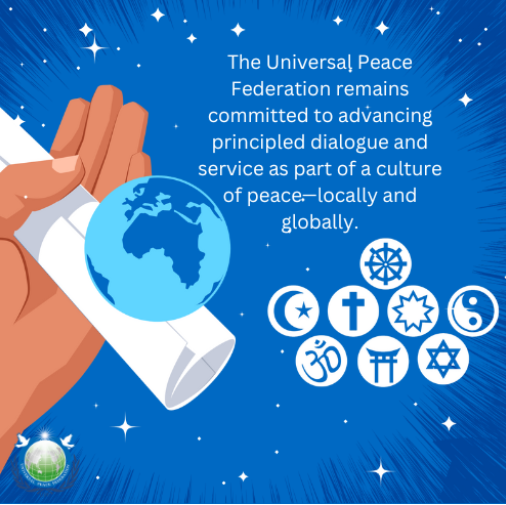
February 2026 showed that interfaith work is increasingly treated as a component of public responsibility, not only private belief. When governments affirm equal dignity, when religious councils cooperate across boundaries, and when local communities choose dialogue instead of suspicion, the social foundations of peace strengthen. The Universal Peace Federation remains committed to working with the United Nations, governments, faith communities, and civil society partners to deepen that cooperation and to expand practical projects that serve communities and protect human dignity.